Astronomy Cast


Subscribe

Subscribe
iTunes
HOME FORUM ARCHIVE EDUCATION ABOUT US CONTACT US SUPPORT THE SHOW Astronomy Cast LIVE! *New*

Check out Astronomy Cast LIVE coverage of the American Astronomical Society Meeting in Long Beach

  • Sponsors


  • Blogroll

    • Astronomy a Go-Go
    • Astronomy Media Player
    • Bad Astronomy
    • Quirks and Quarks
    • Skeptic’s Guide to the Universe
    • Skepticality
    • Slacker Astronomy
    • Star Stryder
    • Universe Today
      Support us using Paypal!


  •                                 


  • Shows Index
    • Aliens (1)
    • Amateur Astronomy (5)
      • Observing (5)
    • Astronomy (116)
      • Cosmology (18)
      • Galaxies (10)
      • Nebulae (2)
      • Observing (12)
      • Planets (39)
        • Extrasolar Planets (5)
        • Our Solar System (32)
      • Stars (18)
        • Compact Objects (3)
        • Stellar Evolution (8)
    • Chemistry (1)
    • History (1)
    • Listeners (27)
      • Questions Shows (22)
      • Student Questions (4)
    • People (9)
      • Doing Astronomy (2)
      • Interviews (6)
      • Meetings (5)
    • Physics (30)
      • Forces (9)
      • Particles (8)
      • Relativity (6)
    • Space Flight (8)
    • The Show (3)
      • Meetups (1)


  • Collaborators
    Universe Today
    Star Stryder
    Bad Astronomy


    Past Shows
    • Ep. 122: How Old is the Universe?
    • Questions Show: Stellar Roche Limits, Seeing Black Holes, and Water on Mars
    • Ep. 121: Spacesuits
    • Ep. 120: The Christmas Star
    • Questions Show: Different Fields of Astronomy, Our Sibling Stars, and Hidden Lagrange Points
    • Ep. 119: Robots in Space
    • Questions Show: Distance in Space, Changing Earth's Orbit, and Different Sized Stars
    • Ep. 118: Sky Surveys
    • Ep. 117: Time
    • Ep. 116: Molecules in Space
    • Ep. 115: The Moon, Part 3: Return to the Moon
    • Questions Show: Spiral Arms, Seismic Waves on the Sun, and our Favorite Gear
    • Ep. 114: The Moon, Part 2 - Exploration of the Moon
    • Questions Show: Ice in Space, Expansion of the Universe, and Death from the Skies
    • Ep. 113: The Moon, Part 1
    • Questions Show: Orbit of the Planets, Green Stars, and Oort Cloud Contamination
    • Ep. 112: Death From the Skies, Interview with Phil Plait
    • Questions Show: Relativity, Relativity and More Relativity
    • Ep. 111: Nebulae
    • Questions Show: Galactic Dust, the Speed of Photons, and the Big Bang Calculations
    • Ep. 110: The Search for Extraterrestrial Intelligence
    • Questions Show: Alignment with the Galactic Plane, Destruction from Venus, and the Death of the Solar System
    • Ep. 109: The Life of Other Stars
    • Questions Show - Running Out of Gravitons and Hitting the Brakes at Light Speed
    • Ep. 108: The Life of the Sun
    • Questions Show - light speed, Andromeda galaxy, dark matter and black holes
    • Ep. 107: Nucleosynthesis: Elements from Stars
    • Questions Show - Black Hole Surfaces, Magnetic Field Strengths, and the Speed of Gravitons
    • Ep. 106: The Search for the Theory of Everything
    • Student Questions Show: Leelanau School
    • Ep. 105: The Strong and Weak Nuclear Forces
    • Ep 104: Science Fiction at Dragon*Con with Plait and Grazier
    • Ep. 103: Electromagnetism
    • Ep 102: Gravity
    • Ep. 101: Advanced Propulsion Systems
    • Ep. 100: Rockets
    • Ep. 99: The Milky Way
    • Ep. 98: Quasars
    • Ep. 97: Galaxies
    • Ep. 96: Humans to Mars, Part 3 - Terraforming Mars
    • Student Questions: Collinsville High School
    • Ep. 95: Humans to Mars, Part 2 - Colonists
    • Ep 94: Humans to Mars, Part 1 - Scientists
    • Ep. 93: Missions to Mars, Part 2
    • Ep. 92: Missions to Mars, Part 1
    • Ep. 91: The Search for Water on Mars
    • Ep. 90: The Scientific Method
    • Ep. 89: Adaptive Optics
    • Ep. 88: The Hubble Space Telescope
    • Ep. 87: The End of the Universe Part 2: The End of Everything
    • Ep. 86: The End of the Universe Part 1: The End of the Solar System
    • Ep. 85: Detectors
    • Ep. 84: Getting Around the Solar System
    • Ep. 83: Wave Particle Duality
    • Ep. 82: Space Junk
    • Ep. 81: Questions on the Shape, Size and Centre of the Universe
    • Ep. 80: Craters
    • Ep. 79: How Big is the Universe?
    • Ep. 78: What is the Shape of the Universe?
    • Ep. 77: Where is the Centre of the Universe?
    • Ep. 76: Lagrange Points
    • Student Questions: Curtis High School
    • Ep. 75: Stellar Populations
    • Ep. 74: Antimatter
    • Ep. 73: Questions Show #8
    • Ep. 72: Cosmic Rays
    • Ep. 71: Gravitational Waves
    • Ep. 70: How To Win a Nobel Prize
    • Student Questions: Farmersburg
    • Ep. 69: The Large Hadron Collider and the Search for the Higgs-Boson
    • Ep. 68: Globular Clusters
    • Ep. 67: Building a Career in Astronomy
    • Ep. 66: How Amateurs Can Contribute to Astronomy
    • Ep. 65: The End of Our Tour Through the Solar System
    • Ep. 64: Pluto and the Icy Outer Solar System
    • Ep. 63: Neptune
    • Ep. 62: Uranus
    • Ep. 61: Saturn's Moons
    • Ep. 60: Questions Show #7
    • Ep. 59: Saturn
    • Ep. 58: Inflation
    • Ep. 57: Jupiter's Moons
    • Ep. 56: Jupiter
    • Ep. 55: The Asteroid Belt
    • Ep. 54: Questions Show #6
    • Ep. 53: Astronomy in Science Fiction
    • Special Episode: Panspermia
    • Ep. 52: Mars
    • Ep. 51: Earth
    • Ep. 50: Venus
    • Ep. 49: Mercury
    • Ep. 48: Tidal Forces Across the Universe
    • Ep. 47: Tidal Forces
    • Ep. 46: Stellar Nurseries
    • Ep. 45: The Important Numbers in the Universe
    • Listener Survey
    • Ep. 44: Einstein's Theory of General Relativity
    • Ep. 43: Questions Show #5
    • Ep. 42: Magnetism Everywhere
    • Ep. 41: The Rise of the Supertelescopes
    • Ep. 40: American Astronomical Society Meeting, May 2007
    • Ep. 39: Astrology and UFOs
    • Ep. 38: Neutron Stars and their Exotic Cousins
    • Ep. 37: Gravitational Lensing
    • Ep. 36: Gamma-Ray Bursts
    • Ep. 35: Questions Show #4
    • Ep. 34: Discovering Another Earth
    • Ep. 33: Choosing and Using a Telescope
    • Ep. 32: The Search for Neutrinos
    • Ep. 31: String Theory, Time Travel, White Holes, Warp Speed, Multiple Dimensions, and Before the Big Bang
    • Ep. 30: The Sun, Spots and All
    • Ep. 29: Asteroids Make Bad Neighbors
    • Ep. 28: What is the universe expanding into?
    • Ep. 27: Questions Show #3
    • Ep. 26: The Largest Structures in the Universe
    • Ep. 25: The Story of Galaxy Evolution
    • Ep. 24: The Fermi Paradox: Where Are All the Aliens?
    • Ep. 23: Counting Aliens With the Drake Equation
    • Ep. 22: Variable Stars
    • Ep. 21: Questions Show #2
    • Ep. 20: What We Learned from the American Astronomical Society
    • Ep. 19: Comets, Our Icy Friends from the Outer Solar System
    • Special Alert: Go See Comet McNaught
    • Ep. 18: Black Holes Big and Small
    • Ep. 17: Where does the Moon Come From?
    • Ep. 16: Across the Electromagnetic Spectrum
    • Ep. 15: Questions Show #1
    • Ep. 14: We're all Made of Supernovae
    • Ep. 13: Where Do Stars Go When They Die?
    • Ep. 12: Where Do Baby Stars Come From?
    • Ep. 11: A Universe of Dark Energy
    • iPod Issues Fix
    • Ep. 10: Measuring Distance in the Universe
    • Ep. 9: Einstein's Theory of Special Relativity
    • Ep. 8: Meteor Showers. Yes, the sky is falling.
    • Ep. 7: Getting Started in Amateur Astronomy
    • Ep. 6: More Evidence for the Big Bang
    • Ep. 5: The Big Bang and Cosmic Microwave Background
    • Ep. 4: The Search for Dark Matter
    • Ep. 3: Hot Jupiters and Pulsar Planets
    • Ep. 2: In Search of Other Worlds
    • Ep. 1: Pluto's Planetary Identity Crisis
    • Welcome to Astronomy Cast!


Questions Show: Spiral Arms, Seismic Waves on the Sun, and our Favorite Gear

  • November 18th, 2008
  • Like it? Digg-it | Reddit | del.icio.us
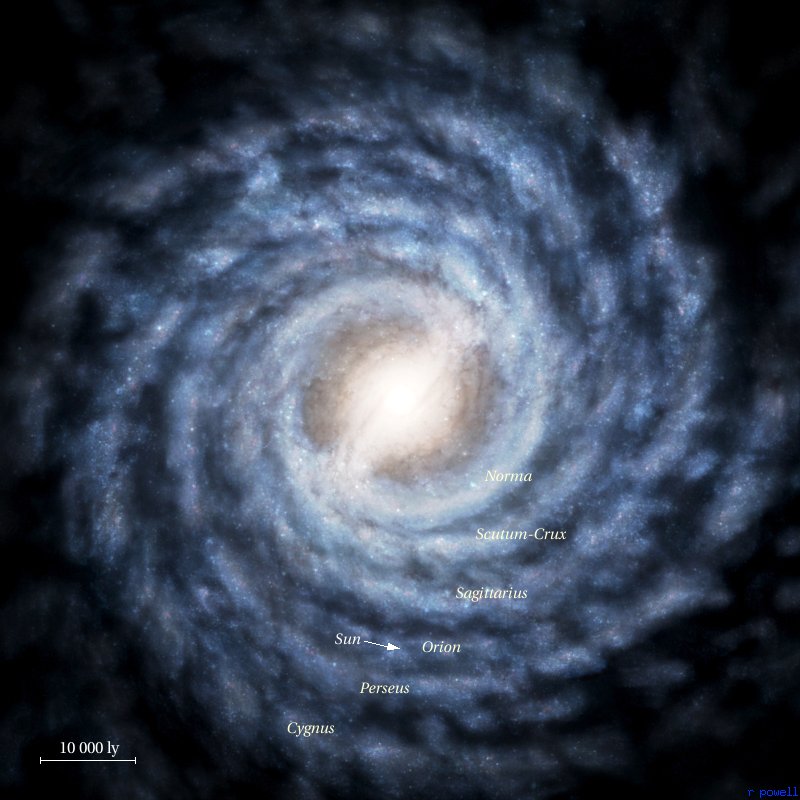
Artist illustration of the Milky Way

Artist illustration of the Milky Way

This week we explore galactic spiral arms, seismic quakes on the Sun, and our picks for astronomy gear. If you've got a question for the Astronomy Cast team, please email it in to info@astronomycast.com and we'll try to tackle it for a future show. Please include your location and a way to pronounce your name.

Spiral Arms, Seismic Waves on the Sun, and our Favorite Gear

Is there a traffic jam in spiral arms of galaxies?

  • Abstract: Density Wave Theory of Galactic Spiral Arms (pdf)
  • Density Wave Theory — Wiki
  • Spiral Arms animation – Vanderbilt U

Why do seismic waves on the sun accelerate?

  • Solar Flares Leave Sun Quaking — SOHO
  • Movie of seismic waves on the sun – Stanford U
  • Abstract:  Properties of Flares-Generated Seismic Waves on the sun – arXiv
  • Mythbusters:  Helium and Sulfur Hexafloride — You Tube

What are Fraser's and Pamela's favorite astronomy gadgets?

  • Fraser:  Green laser pointer
  • comparison of different brands
  • Please be careful when using a green laser pointer!!
  • Pamela:  1. Binoculars (a guide from Astronomy.com)
  • 2.  TelVue Pronto Telescope (a review)
  • 3.  Ritchey-Chretien telescopes
  • CCD – wiki
  • Reviews of different "Go-To" telescopes

Why are the Pioneer spacecrafts slowing down?

  • Pioneer anomaly – Planetary Society
  • Pioneer Anomaly, a deviation from Einstein Gravity? — Universe Today
  • Pioneer Collaboration — ISSI

How can astronomers tell the distance of an object from red- and blue-shifting of light?

  • Doppler shift -- UCLA
  • Cepheid Variable Stars and Distance Determination — Australia Telescope Outreach and Ed.
  • Measuring distances to stars
  • The Cosmic Distance Scale and Standard Candles — UTK
  • Cosmic Distance Ladder -- Wiki
  • Andromeda/Milky Way collision — Hayden Planetarium

Why are galaxies colliding if everything in the universe is moving away from everything else?

  • Colliding Galaxies — UTK
  • How can galaxies collide in an expanding universe? — Cornell U
  • What happens when galaxies collide? — Cornell U

On how much of the sun is fusion taking place?

  • Answer:  about 25%
  • How the sun works — HowStuffWorks
  • Convective zone – U of Michigan
  • Radiative zone – U of Michgan

Why are globular clusters shaped the way they are?

  • Globular Clusters — SEDS
  • Globular Clusters:  The Middle Ages – Star Stryder
  • Abstract: Three Body Interactions of Black Holes in Globular clusters

What is a parsec?

  • Answer:  3.26 lightyears
  • Parsec – World of Astronomy

Meet up with Pamela and Chris Lintott at Mabel's Tavern in London on Nov 23, 2008:  details


Comments
  1. Charles Kuester Says:
    November 24th, 2008 at 8:25 pm

    Great show, as usual.

    When it comes to gadgets for astronomy I found a great one that I could build myself for next to nothing. An image stabilizer for binoculars. Anything more than 7 or 8x is almost impossible to hold steady and I have an old pair of 10×50's that I hardly ever used because of this. So when found this do-it yourself binocular stabilizer on the Sky & telescope website I built one. Find it here:

    http://www.skyandtelescope.com/howto/diy/Image-Stabilize-Your-Binoculars.html

    It's a little bulky and funny looking but It works great!

  2. Stephen Says:
    November 26th, 2008 at 1:40 pm

    Uhm, did a clearer explanation of the twin's paradox get posted somewhere? In the old days, i was clear on this one, now i'm not.

  3. Tom Leach Says:
    November 27th, 2008 at 8:46 am

    Did I hear correctly on your podcast that our Galaxy Milky Way is believed now to have only two arms? (the Orion Arm and the Saggitarius Arm?)

  4. AJenbo Says:
    December 4th, 2008 at 1:45 am

    I keep getting an error when trying to listen to this show :(

  5. Roger Says:
    December 4th, 2008 at 12:51 pm

    I'm keep getting file errors to =(

  6. Stephen Says:
    December 9th, 2008 at 11:09 pm

    Pioneer anomaly. Last i heard, the Planetary Society funded a project to get the old tapes out, copy them to modern media, and start analysis. And, last i heard, about a third of the anomaly has been accounted for by thermal modeling of the space craft. No outgassing. The Pioneer anomaly is a very subtle effect, and would have been overwhelmed by anything so crude. There is simply more radiation going in one direction than another. Photons carry momentum.

    Gear. I like the new Newtonian Dobs with push-to computer locators. You get aperture per dollar like no other scope design can give you. Orion has a 10" version that fits in your car, sets up including 2 star alignment in under 3 minutes in the dark and the cold, hardly ever needs collimation, the finder scope clips on and still doesn't need alignment, and did i mention it's 10"? And it's $700.

    How could you possibly want a 76 mm doublet acromat for $1700 that still needs a mount? For $1600, you can get a Vixen 140 mm 4 element neo-acromat. It's cheaper and nearly twice the aperture! And in no case will your mount fit in carry on.

    And yet there is a 10" Newtonian dob that does fit in carry on. I'm not sure the Johnsonian is still made, however. And Sky & Tel ran an article about a home made 8" that fits in carry on. These scopes include the mount, in carry on.

    But i'm having lots of fun with my laser pointer. Outreach has never been so easy. I know a guy who uses his laser pointer as his finder. He's got it mount on the scope, and just moves the scope until the pointer is where the object is on the chart. I just got my scope mount and haven't had a chance to try it out.

  7. AJenbo Says:
    December 12th, 2008 at 3:34 am

    I sent an email to the AstronomyCast Team and the episode is now fixed :D

  8. Tymnenuntee Says:
    December 17th, 2008 at 6:28 am

    ???????? | ????????????? ??? ?? ????? ????? ? ?? http://p1p3.net ???? ?? ??? ?? ? ???????? ??????? ?


Leave a Reply


HOME FORUM ARCHIVE EDUCATION ABOUT US CONTACT US SUPPORT THE SHOW Astronomy Cast LIVE!

Take a weekly facts-based journey through the cosmos with Astronomy Cast.