
Podcast: Play in new window | Download
Subscribe: RSS
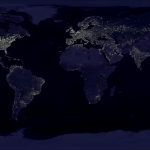
Earth at night
If you live in a city, it’s possible that you’ve never seen the Milky Way with your own eyes. To really appreciate everything the night skies have to offer, you’ve got to get out of the city, away from the lights, where the skies are really dark. But those places are getting harder and harder to find. Let’s talk about what you can do to find dark skies, fight to make the skies darker, and how to make the most of wherever you live.
Show Notes
Transcript: Dark SkiesDownload the transcriptFraser: Astronomy Cast Episode 153 for Monday August 31, 2009: Dark Skies. Welcome to Astronomy Cast, our weekly facts-based journey through the cosmos, where we help you understand not only what we know, but how we know what we know. My name is Fraser Cain, I’m the publisher of Universe Today, and with me is Dr. Pamela Gay, a professor at Southern Illinois University Edwardsville. Hey Pamela. Pamela: Hey Fraser, how’s it going? Fraser: Good. So, this is… once again we’re still catching up from the past, but this is Episode 153, and then next Episode 154 is going to be the live show that you did at DragonCon with… Pamela: Yay!! Seth Shostak. Fraser: With a few friends, yep. Which, if we put it up on the date, it would be Sept. 7, so it should all work out perfectly. And later on, no one will ever be able to tell our terrible lies… Alright, so if you live in a city, it’s possible that you’ve never seen the Milky Way with your own eyes. So, to really appreciate everything that night skies have to offer, you’ve got to get out of the city, away from the lights, where the skies are really dark. But those places are getting harder and harder to find. So, let’s talk about what you can do to find some dark skies, to fight to make the skies darker, and how to make the most of wherever you live. But first, Pamela, I think we should make everyone drool, can we hear a really cool dark sky story? Pamela: Oh, for me it was the first time I went observing out at McDonald Observatory. I drove and drove and drove and drove and drove and drove during daylight to get out there because I had homework due, and I couldn’t leave for the observatory until Fraser: Wow. So, for me, well I grew up on a small island off the west coast of Vancouver Island and pretty far away from civilization, so, in fact, we had really dark skies all the time. But actually just a couple of years ago I took my… my kids and I go back every summer to watch the Perseids. So we stayed up… they did the best they could… stayed up to about 10 o’clock watching the Perseids. We were all sleeping outside, so we just fell asleep. I think I woke up about 2 in the morning, 3 in the morning, and that’s when you see the real show. So then it was just meteors, and the Milky Way was high overhead and just so vivid, so clear… it’s just amazing. So, if you go out and you think you’re seeing dark skies at like 11 o’clock, it’s nothing to what you see at like 2… 2 or 3 in the morning. And for all you poor suckers living in the cities…. Pamela: And I was one of those suckers for a lot of years… so I know your pain. Fraser: Yeah, so what’s going on then… why is the view from the city so bad? Pamela: Well, we’re dealing with two different problems. The biggest problem is that our atmosphere is pretty good at reflecting light, and if the light it’s reflecting down… the light that’s scattering in the atmosphere is greater than the amount of light coming down from the star… you’re never going to see the star. In cities, in rural areas with people with paranoid lighting schemes, there’s huge amounts of light that’s getting directed straight into the sky. When you go to archaeological sites, architecture sites, places with pretty buildings where all the buildings are illuminated, all of that light that isn’t landing directly on the building–it’s going straight up into the sky. And all of this light in our atmosphere on a cloudy night, it makes the clouds glow red, glow orange, glow white if you’re someplace with a lot of fluorescents, and all of that is skyward-directed light. If you actually go someplace dark–this really confused me the first time I saw it–the places on the sky that are darkest… that’s where the clouds are. I’m used to being from a city or suburbs with lots of light… you look up and oh, that bright orange thing is a cloud. No, in a dark site, the darkest places on the sky are the clouds. And in a truly dark site, the starlight is bright enough to read by, and a cloudy night is so dark you can’t walk. Fraser: It’s interesting that you’re in the city and you can have like… even in a place with no streetlights, there’s still enough reflected light coming off of the clouds that everything is always sort of illuminated. And you don’t really appreciate how dark things can get until you are out in the wilderness or away from the lights, and now suddenly you just have the starlight and it is dark! Pamela: Right, nothing’s quite as dark as a cloudy, cloudy night in a dark sky. And nothing’s quite as bright as a cloudy, cloudy night in a light-polluted city. Fraser: So you’ve got the illumination from the city being sent upward, and then it’s bouncing off either clouds, or even just the atmosphere itself. Pamela: Yeah. The other one… well, our own eyes have to dark-adapt. If you’re inside in a bright kitchen, for instance…. you have a farmhouse and a really dark site… you’re good to the environment so you have really good blinds and curtains both up to make sure that no scattered light gets out your window, and you’re hanging out in the kitchen making hot cocoa before you go out to go observing, then you step outside into the pitch darkness of your farm country home and you look up…. and you don’t see a thing. You have to wait for your eyes to dark adapt. Now the thing is, is if you’re someplace where you have your neighbor’s security light within your line of sight, you’re someplace where you have streetlights within your line of sight… that’s what I had growing up, I would go out to observe in the driveway but we had streetlights because I lived in the suburbs with sidewalks and lots of safety stuff. And all of the streetlights, the second your eye catches them… your eyes… they constrict and now suddenly your eyes aren’t sensitive enough to see the faint stars. So there’s a lot of places that if you could just somehow stick yourself in the bottom of a well–a very short well so you could easily climb back out–by not having any lights within your peripheral vision, you’re suddenly able to see far more stars. And even though it’s not safe, if you’re in a city, the best place to go observing is down that dark spooky alley where there’s no windows facing the alley. And from that dark scary alley you’ll be able to make out the stars between the buildings. Fraser: So let’s say that you live in a city with bright lights, bright skies, and you want to truly appreciate dark skies, you want to see the Milky Way for the first time… what do you have to do? Pamela: Well, the easiest thing to do is look at a map, find the nearest completely empty space, and drive there. You need to find someplace where there’s just not humans around. And a lot of times you don’t have to go very far. From Austin, Texas we’d go up to a state park called Canyon of the Eagles. It was a nice large park and there was an observatory in the center, and from a lot of the different camp sites you can still get really dark skies… you just have more trees when you’re in the camp sites. Find that nearby park, and there’s also a lot of places called starlight reserves, dark sky parks, which are large areas of acreage that are set aside specifically to try and keep a place where future generations can go out and see the stars that are disappearing one by one to the people who live in communities. Fraser: Yeah, in Vancouver there’s a dark sky park out in the Fraser Valley, sort of out by a town called Abbotsford, and I’ve been out there a couple of times. It’s out of the city but then there’s a mountain that blocks… that’s right in between you and Vancouver. So a lot of the light coming from Vancouver is blocked off there, and it’s almost like when you come around the corner to the dark sky park, everything darkens much more and you can really see a beautiful night sky. There’s a great astronomical community that sets up telescopes there and you can go out and look through people’s scopes… it’s great. So, I know there’s a bunch of them in Canada… I’m sure there’s a bunch in the U.S., and even around the world. So if you could find your nearest dark sky park… but how far… let’s say you live in–I don’t know–Los Angeles… you know, how far north up into the Mohave, how far would you have to get before you could really start to see some dark skies? Pamela: The dark, dark skies…. three hours out of a city is enough. McDonald Observatory, which is one of the darkest sites in North America, is located 3 hours from El Paso, 3 hours from Odessa, and it’s a boring, boring, boring drive… but that drive’s worth it. It’s basically the edge of an equilateral triangle from these two cities and there is often the horizon… you do see some light… Ft. Stockton’s out there, but more importantly, there’s some little retirement communities cropping up on the sides of the mountains, but those 3 hours are enough to get some of the nicest skies in the United States. Fraser: Yeah, so even 1-2 hours out of a town… 3 hours if you can find a really dark place… you know go camping… Pamela: One of the easiest ways to find a bunch of really nice dark sky sites is find out where the astronomy clubs are meeting. There’s all over the place different star parties run by different regional and national organizations. There’s the Texas Star Party, there’s Stellafane, there’s the Winter Star Party that’s held out in the Florida Keys. Look for these lists of star parties, and then look to see where they’re located, and those are the places that you want to go. Fraser: Is there a direction you want to head? Is it better to head north or south, east or west? Pamela: It depends on what you’re trying to look at. So for instance, if you know there’s some specific comet… there’s not any really interesting ones right now, but should, when you’re listening to the show, there’s some awesome comet in the sky… if you’re in a city–figure out what direction is the comet in, and drive in a direction where the city is 180 degrees around the sky from you. So, say that there’s this amazing comet that’s in the north, well that means that you want to drive north from the city so that the city is behind you in the south, and the comet’s in front of you in the darker part of the sky in the north. Fraser: Right, and I guess it depends if you’re trying to see something near sunrise or sunset? Pamela: Right. So there, if you’re trying to find something that’s rising right before sunrise, well that’s something that’s going to be up in the east so head east out of the city and leave the city behind you in the west. Fraser: Right, that way you have the best chance to see it rising up. Pamela: Exactly. Fraser: Then what other things… if you want to adapt your eyes–how long are you looking at? What are some good ways to do that? Pamela: In general, 20 minutes is the right amount of time to get your eyes fully adapted. They’ll keep getting a little bit better after that, but 20 minutes is enough to get most of the way there. And even after 5 or 10 minutes, you start to see amazing differences. Any of you who’ve had a spouse turn the light on and off on you after you’ve gone to bed, know the “oh, God, I’m blind!” moment followed by the a few minutes later…. oh, I’m fine again, just looking at random light coming in through your bedroom window. It helps not to drink caffeine… it also can affect things. So basically look for chemicals that won’t cause your eyes to act in funny ways. So basic common sense… And keep yourself well-hydrated… that always helps everything. Fraser: Let’s say you’ve got your eyes adapted, what can you do to protect them? Like if you’re trying to…. people turning on lights… things like that… Pamela: Right. So, star charts are all of our friends… I admit I use them all the time and computers with star charts also exist. The thing you don’t want to expose your eyes to is light that’s white or blue, or any color other than nice deep red. What people most often do, is that they get sheets of red cellophane and they coat all of their flashlights, they coat their computer screens. A lot of software has night-sky viewing modes that will take over your whole computer, so if you’re using some of the software… Bisque software… it has a night-sky mode such that when you open Excel, Excel will still have deep-red background with black letters on top of it. This will help protect your eyes. Flashlights, of course… I actually go the extra step further because red cellophane can come off no matter what amount of duct tape you use… you can puncture it… some mistake can happen. Red nail polish–you may be a guy and you may feel weird buying the red nail polish, but painting red nail polish on the front of your flashlight… try one coat… turn your flashlight on. Try 2 coats… it’s a good way to get the precise amount of shielding that you need that allows you to just barely make out what your star chart says. Fraser: That’s a good idea. And that does the trick… you’ve done that… Pamela: Yeah, it works perfectly. Fraser: Because I… often you can get from like army surplus stores… they have these army flashlights and they’ve got a whole bunch of different filters you can stick in front of the flashlight… you unscrew the front and stick in a red filter and screw it back in, and those are pretty good. But I can almost imagine that they’re not dark enough… like they’re dark enough if you’re trying to sneak through the forest with your comrades, but maybe not dark enough if you’re trying to make sure that your eyes are perfectly… stay dark… oriented to the darkness. So you may want to take one of those and even, as you said, put more nail polish on it to even darken it further. That’s a really good trick. Pamela: And Maglite also has those filters and they’re not bad, so if you’re doing a public event where you’re still going to want to use the red flashlights, but you know that there’s going to be people with car headlights now and then… it’s a cheap option that doesn’t require the humiliation of going to the nail polish section. But, there’s other things that you have to be aware of, especially if you’re doing star parties and you’re with a bunch of dark-sky friends and it’s not open to the public… closed… you’re there to observe. Parking lights on cars are evil. I actually had a student… he was awesome… he popped the fuses for his car’s lights because he had daytime running lights, he had back-up lights, and he had parking lights, and they’d all randomly turn themselves on and off and he’d just pop the fuses for them… put the fuses back in when he got out of the dark sky site. It worked. It was slightly insane… I think he drove with his door open so that he could keep the car going along the little line on the side of the road… but it worked. Fraser: Right, and even just opening up your car…. the dome light comes on… arrgghhh! It’s a bright white light and boom–your eyes are wrecked. Pamela: And laptops… Fraser: Yeah, open one of those up… or even like a cell phone will get ya… Pamela: And the problem that you have to worry about now… and this is where duct tape becomes your friend… or electrical tape also works really well and comes off easier… is my Mac has a heartbeat, and there’s the little green light on the power supply… and so all the things that would annoy you in a hotel room are way worse when you’re at a star party trying to protect your eyes while trying to use your computer. Fraser: And I guess, then, the last thing that we wanted to talk about today is the battle… the fight to keep the skies dark and to get them back to some kind of semblance of darkness. So, what can cities do to stop polluting the skies? Pamela: This is really the central issue. We spend somewhere between 1 and 2 billion dollars a year on light where the photons are going into the sky instead of onto the ground here in the United States. And that’s a lot of money! That is 1/20 of NASA’s budget… somewhere between 1/10 and 1/20 of NASA’s budget… I’d love to see that money instead go into research, go into feeding people, going into all sorts of other programs, but no… it’s going into illuminating things for astronauts. The best thing you can do is figure out what are your lights actually lighting up and then replacing them with lights that light up what you meant to light up. The most egregious form of light is the nice historic pretty ones where you have a pole, and you have at the very top of the pole a light–usually in a globe… and the majority of the light is going straight up into the sky… and there’s actually a shadow cast around the base of the pole. So, if you’re walking along at night through a park that’s lit up with these nice pretty historic-looking lights, a mugger standing up against the base of the pole would be really hard to see, and you also end up with these circles of darkness with these larger circles of kind of brightness around them, and the trees are really nicely illuminated… and I’m not worried about attack by squirrel in the middle of the night… by getting lights where you have the lights on little arms and all of the light being pointed straight down like a lot of parking lots have… those are much better. You want to replace incandescent bulbs with LEDs or fluorescent bulbs. LEDs are in many ways the most cost-effective way to go because they take so little energy, and you have to replace them–but very very infrequently. Fraser: Right. And they’re throwing out photons in a nice straight line from wherever they’re being emitted. It’s not like a… something that’s being heated up… a coil or a circle and the light just coming out in every direction. Pamela: Yes… so just a plane panel of LEDs… it’s low-cost in terms of longevity. It’ll cost a lot more to set up initially, and I know at the end of the day you have to worry about how much money do I have this month, not how much money do I have in the next 3 years, but once you’ve made that initial investment, you’re protecting the sky. Fraser: Well, I actually found that Walmart is selling LED lights now… like light bulbs…. Pamela: Really? Fraser: Yeah, I just bought a bunch a couple a weeks ago. I went to Walmart and they have a whole big wall of the fluorescent ones, and then they also have a bunch of LED lights, and these will fit into your light bulb socket… and they use 4 Watts, or 1 Watt… it’s quite amazing. Now they’re not very bright, they’re definitely not a replacement, but like, for example, for the kids… I give the kids… they both have LED lights for their rooms and they just read with those lights, and if they forget to turn them off, it’s no big deal because they’re just sipping power. But outside… same deal. You put one outside and you can illuminate an area so you can not trip over your front steps but you’re definitely not wasting energy and not firing lights up into the air. Yeah… check out Walmart… you’d be amazed at what they’ve got now in terms of LED lighting. Pamela: That’s cool. See we replaced all of the lightbulbs in our house with compact fluorescents and we just haven’t had a bulb go out… So in three years…. Fraser: Yeah, well that’s so… you know, that’s so “two years ago.” Now it’s all LED so… Pamela: Yeah, we bought our house 3 years ago, so we’re all “three years ago.” That’s awesome, and protecting dark skies has so many different consequences. We’ve found that human beings… that if you’re in a brightly-lit bedroom, you’re not going to sleep as well as you would if you were someplace completely dark, so that streetlight outside your window that’s illuminating inside your bedroom instead of on the sidewalk, that’s a health hazard to you. Migrating birds get confused by all of these bright lights. Moths… we have problems with our ecosystem because things eat moths and moths are attracted to lights so the things that aren’t near the lights that would like to eat the moths are in trouble. The moths aren’t finding each other to reproduce, and lightning bugs can’t see each other anymore… imagine you’re a poor innocent lightning bug and you’re flying around in someone’s well-lit front yard at night and you can’t find your buddies. There are all these things that we just don’t think about. Sea turtles everyone knows about, but the lightning bugs… it’s so obvious in some ways and yet so easily forgotten. Fraser: So, you know, take responsibility. Swap out your big flood lights and your bulb lights for things that are a lot more directional… things that can just cast a beam down to the places you want illuminated outside. And really, you know, does it really matter to have some corner of your property illuminated? Pamela: Yeah, does the frog really want to be lit up at night? And, use motion-sensitive lights. If you’re worried about crime… it’ll light up for every single one of the neighbor’s cats… I guarantee it, but that’s ok. Fraser: And then you want to take things to another… to a higher level and nag your city. Right? Pamela: Yeah. And there’re lots of organizations out there to help you. The International Dark Sky Association is there. There’s an IYA Cornerstone Project–Dark Skies Awareness. And there’re people that are documenting how bad it is in different places. Globe at Night and the World Wide Star Count are two projects… Globe at Night occurs roughly every March and the Great World Wide Star Count occurs roughly every October. This year it’ll be October 9th – 23rd in 2009. Fraser: Right, and that’s coming up, so if you want to get involved… chart your crappy skies… this is your chance. Pamela: And both of these sites… they give you star charts and they send you out and they’re like… ok, what can you see? Tell us! And then you can use this data to go into your community. And if you want to be really qualitative quantitative [ed.], there’s an instrument called a dark sky meter that you can take around to different sites in your town and measure how much light there is in the sky, and say… look, there’s this one rural neighborhood that has no city street lights, and it’s really dark skies… and look, the crime rate is low. Here’s this other place that has the same low crime rate but it’s filled with street lights, all the houses are illuminated because they’re big and fancy, but the little kids living there can’t see the stars. Fraser: Right. And this is the… I’ve heard that this is a bit of a fallacy… that criminals like bright city lights as much as anyone because that lets them see what they’re doing. Pamela: Exactly. I can’t even stick my key in my doorknob at home… how can you pick the lock if you can’t see it? Fraser: Yeah, exactly… so that doesn’t necessarily make sense. So there are a bunch of organizations that you can get involved with who are trying to battle to get these better lighting systems put into cities. There are groups that will help you get involved sort of at a scientific level to chart the state of the skies right now. So, there are a lot of ways to get involved. So, I think for both of us… if you haven’t seen the Milky Way with your own eyes….I mean we’ve already nagged you about Saturn… see Saturn in a telescope! But if you haven’t seen the Milky Way with your own eyeballs, organize a trip with your buddies… get out into the wilderness and see the Milky Way. Get up at four in the morning and go outside… Pamela: And those of you in the southern hemisphere, you’re losing the Magellanic Clouds, too, and that’s just wrong, those are cool! Fraser: Yeah… I’ve never seen those. Alright, well thank you very much Pamela, and so hopefully next week will be the DragonCon episode, and then back on to our regular shows. So we’ll talk to you… whenever we talk to you next! Pamela: Ok, sounds great Fraser… I’ll talk to you later. Fraser: Bye. Pamela: Bye-bye. This transcript is not an exact match to the audio file. It has been edited for clarity. |